Supplement Facts Label
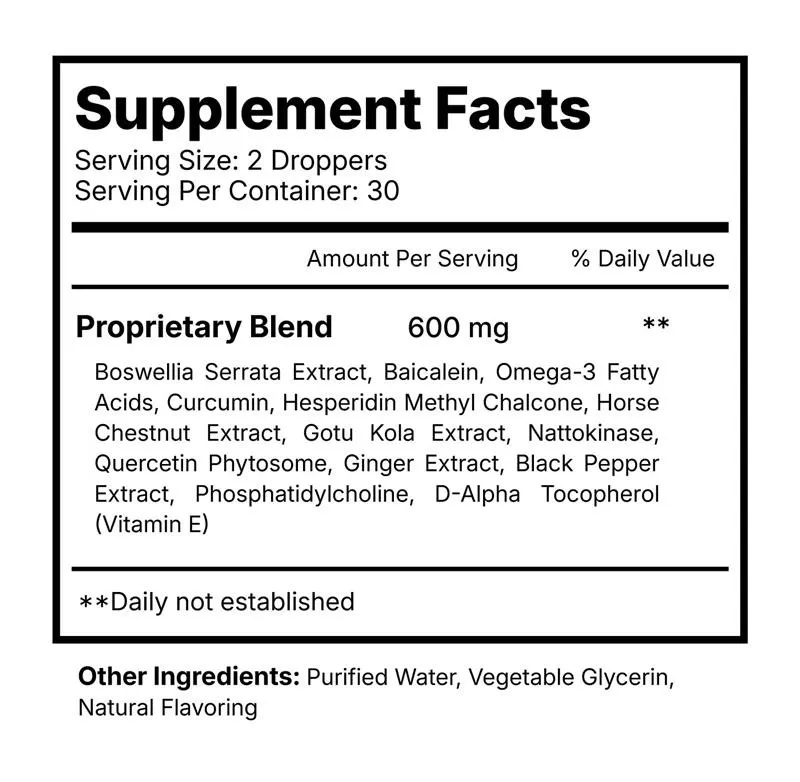
Serving size: 2 droppers · 30 servings per container · 600 mg proprietary blend. Other ingredients: purified water, vegetable glycerin, natural flavoring. Alcohol-free.
A close look at all 13 botanicals in Lymph Tonic's 600 mg proprietary blend, the research behind the lead ingredients, and an honest note on what the brand does and doesn't disclose.
Lymph Tonic's 600 mg proprietary blend contains 13 botanicals: horse chestnut, gotu kola, hesperidin methyl chalcone, quercetin phytosome, curcumin, baicalein, boswellia, nattokinase, ginger, black pepper, omega-3 fatty acids, phosphatidylcholine, and vitamin E. The lead circulation ingredients have real research; individual doses are not published.
Lymph Tonic combines traditional circulatory botanicals with supportive nutrients. Below is what each ingredient does and, for the lead ingredients, the evidence behind it - followed by an honest look at the proprietary-blend transparency gap.
Serving size: 2 droppers · 30 servings per container · 600 mg proprietary blend. Other ingredients: purified water, vegetable glycerin, natural flavoring. Alcohol-free.
Standardized to aescin, horse chestnut is one of the most-researched botanicals for venous circulation. A Cochrane review of 17 randomized trials found it reduced leg swelling and symptoms of chronic venous insufficiency, with effects comparable to compression stockings in one study (PMID 23152216, 9828868).
Contains triterpenes (asiaticoside) that support vein wall integrity and microcirculation. A systematic review of eight trials found improvement in venous insufficiency signs such as ankle swelling and leg heaviness (PMID 23533507).
A citrus flavonoid (a phlebotonic) used to support venous tone and capillary integrity, helping reduce the fluid leakage that drives swelling. Flavonoids of this class showed benefit for edema in a Cochrane review (PMID 27048768).
A flavonoid in an absorption-enhanced phytosome form. It supports capillary integrity, reduces capillary permeability, and has documented anti-inflammatory and antioxidant activity (PMID 26999194).
Turmeric's active polyphenol, with well-documented anti-inflammatory and antioxidant effects. Black pepper (piperine) is included because it boosts curcumin absorption dramatically (PMID 29065496).
A fibrinolytic enzyme derived from fermented soy (natto), traditionally used to support healthy blood flow and circulation. Important: it may affect blood clotting - see the safety cautions if you take blood thinners.
| Ingredient | Role in the Formula |
|---|---|
| Horse Chestnut Extract | Vein tone, reduces leg swelling (aescin) |
| Gotu Kola Extract | Microcirculation, vein wall integrity |
| Hesperidin Methyl Chalcone | Capillary strength, venous tone (flavonoid) |
| Quercetin Phytosome | Capillary integrity, anti-inflammatory |
| Curcumin | Anti-inflammatory, antioxidant |
| Baicalein | Flavonoid, anti-inflammatory support |
| Boswellia Serrata Extract | Anti-inflammatory (5-LOX pathway) |
| Nattokinase | Fibrinolytic enzyme, circulatory support |
| Ginger Extract | Circulation, anti-inflammatory |
| Black Pepper Extract | Piperine - boosts absorption of curcumin |
| Omega-3 Fatty Acids | Anti-inflammatory, membrane health |
| Phosphatidylcholine | Cell membrane & lipid transport support |
| D-Alpha Tocopherol (Vitamin E) | Antioxidant protection |
A responsible review names the gaps. Lymph Tonic lists its 13 ingredients but combines them in a single 600 mg proprietary blend without disclosing the amount of each. This is the formula's biggest transparency limitation. It matters because the research doses for some ingredients are substantial on their own - horse chestnut trials often use around 600 mg of extract by itself, and gotu kola studies use 60-180 mg/day. With 13 ingredients sharing 600 mg total, several are almost certainly present below their researched standalone doses.
This doesn't mean Lymph Tonic doesn't work - the ingredients are well-chosen and the lead botanicals are genuinely research-backed. It means you should view it as evidence-informed nutritional support rather than a clinically-proven treatment, and that requesting a Certificate of Analysis (and using the 60-day guarantee) is the smart way to verify and test it for yourself.
Because nattokinase and horse chestnut may affect blood clotting, anyone on blood-thinning or anticoagulant medication, with a bleeding disorder, or scheduled for surgery should consult a doctor before taking Lymph Tonic. Those who are pregnant, nursing, under 18, or managing kidney or liver disease should also get medical guidance first.
Pittler MH, Ernst E. (2012) "Horse chestnut seed extract for chronic venous insufficiency." Cochrane Database Syst Rev. PMID: 23152216
Chong NJ, Aziz Z. (2013) "A systematic review of the efficacy of Centella asiatica for improvement of the signs and symptoms of chronic venous insufficiency." Evid Based Complement Alternat Med. PMID: 23533507
Martinez-Zapata MJ, et al. (2016) "Phlebotonics for venous insufficiency." Cochrane Database Syst Rev. PMID: 27048768
Hewlings SJ, Kalman DS. (2017) "Curcumin: a review of its effects on human health." Foods. PMID: 29065496
Li Y, et al. (2016) "Quercetin, inflammation and immunity." Nutrients. PMID: 26999194
Citations refer to research on the individual ingredients, not on the Lymph Tonic product itself. Many studies use doses, forms, or populations (often people with chronic venous insufficiency) that may differ from the amounts in a multi-ingredient blend. Lymph Tonic is a dietary supplement; these statements have not been evaluated by the FDA and are not intended to diagnose, treat, cure, or prevent any disease.
Every order is backed by a 60-day money-back guarantee - time to see how your body responds.
Order from Official Site